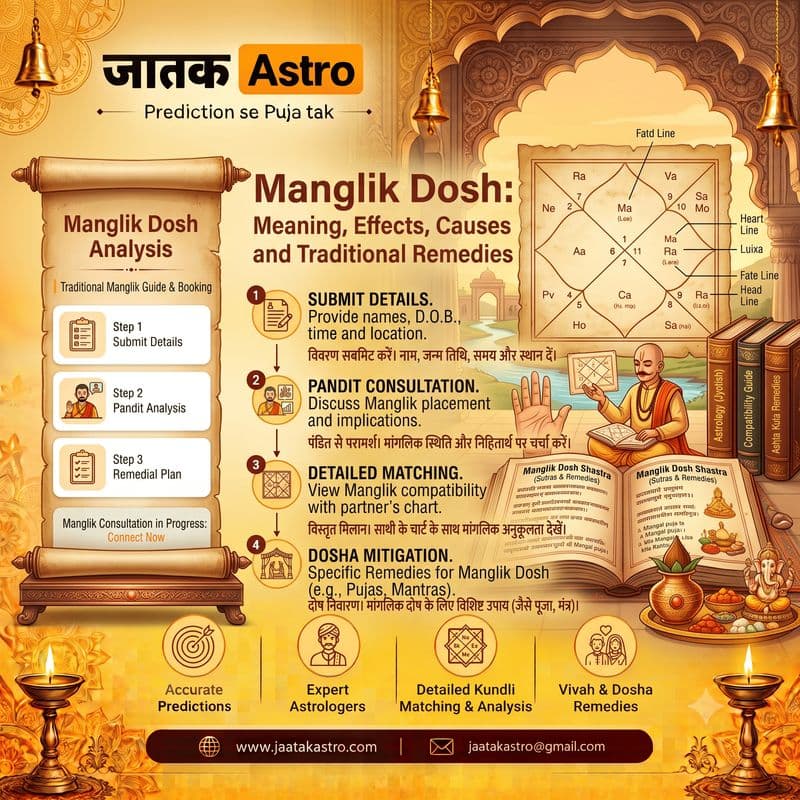
What Is Manglik Dosh?
Manglik Dosh, commonly called Mangal Dosha or Kuja Dosha, is a concept found in traditional Vedic astrology.
According to astrological beliefs, the position of Mars (Mangal) in a person's birth chart can influence certain areas of life. When Mars is placed in particular houses of the Kundli, the person may traditionally be described as a Manglik.
The concept is discussed most often in connection with marriage and compatibility.
However, Manglik Dosh is not something that should be understood from a single planetary position alone. Traditional astrologers generally examine the complete birth chart, including Mars, the seventh house, Venus, Jupiter, the Moon, and other planetary combinations before drawing conclusions.
Why Is Mars Important in Vedic Astrology?
Mars is associated with qualities such as energy, courage, confidence, passion, ambition, and assertiveness.
These qualities can be constructive when expressed positively. At the same time, traditional astrology associates an afflicted or strongly placed Mars with impatience, aggression, arguments, or impulsive behavior in certain circumstances.
This is one reason Mars receives considerable attention when astrologers examine marriage-related aspects of a Kundli.
It is important to remember that these are traditional astrological interpretations, not scientifically established effects of planetary positions on personality or relationships.
How Is Manglik Dosh Formed?
In commonly followed Vedic astrology traditions, Manglik Dosh is considered when Mars occupies certain houses in the birth chart.
Depending on the astrological tradition being followed, these houses may include the:
- 1st house
- 4th house
- 7th house
- 8th house
- 12th house
Some astrologers also consider the position of Mars from the Moon and Venus when assessing Mangal Dosha.
Because different schools of Vedic astrology use somewhat different rules, two astrologers may not always interpret the same Kundli in exactly the same way.
That is why simply hearing that Mars is in one of these houses does not necessarily provide a complete picture.
What Does It Mean to Be Manglik?
A person whose birth chart is considered to contain Mangal Dosha is traditionally referred to as Manglik.
The term is commonly used in the context of marriage matching. Traditionally, astrologers may compare the Manglik status of both partners before making a compatibility assessment.
In some traditions, a Manglik person is matched with another Manglik person because it is believed that similar planetary influences may balance each other.
However, modern practitioners may take a broader approach and examine the entire Kundli rather than making a decision based only on Manglik status.
Traditional Beliefs About Manglik Dosh and Marriage
Manglik Dosh has traditionally been associated with certain challenges in married life.
Some astrological interpretations suggest that an unfavorable Mars placement may be associated with:
- Frequent disagreements between partners
- Impatience or short temper
- Difficulty adjusting with a spouse
- Emotional tension
- Delays in marriage
- Relationship misunderstandings
These are beliefs within Vedic astrology, not guaranteed outcomes.
Having Manglik Dosh does not mean that a person will necessarily experience problems in marriage. Many factors are considered in a complete Kundli, and individual experiences vary greatly.
Does Manglik Dosh Always Cause Problems in Marriage?
No.
This is one of the most important points to understand.
Manglik Dosh is often discussed as though its presence automatically means that a marriage will face difficulties. Traditional astrology itself can be more nuanced than that.
Astrologers may look for factors that reduce, modify, or cancel the influence traditionally attributed to Mangal Dosha. These are often referred to as Mangal Dosha cancellation or cancellation combinations.
The strength and placement of Mars, the condition of the seventh house, the position of the seventh lord, Venus, Jupiter, the Moon, and other planetary combinations may all be considered.
Therefore, a Kundli should not be judged solely by asking, "Is this person Manglik?"
What Is Mangal Dosha Cancellation?
In Vedic astrology, certain planetary combinations are traditionally believed to reduce or cancel the effects associated with Manglik Dosh.
These conditions can vary depending on the astrological school and the method used to calculate the Kundli.
Some astrologers consider factors such as:
- The sign in which Mars is placed
- The strength of Mars
- The position of the seventh lord
- Beneficial aspects from other planets
- The placement of Jupiter or Venus
- Similar Manglik influences in both charts
- Specific combinations described in classical astrological traditions
This is why a qualified astrologer usually examines the complete horoscope rather than declaring a person Manglik based on one placement.
Manglik Dosh and Kundli Matching
Kundli matching is traditionally performed before marriage in many Hindu families.
When Manglik Dosh is involved, astrologers may compare the birth charts of both individuals. This process is commonly called Guna Milan or horoscope matching.
However, Guna Milan and Mangal Dosha are not the same thing.
Guna Milan generally evaluates different compatibility factors, while Mangal Dosha is one particular consideration involving Mars.
A broader horoscope analysis may provide more context than looking at the Manglik status alone.
Common Manglik Dosh Remedies
Vedic astrology offers several traditional remedies for Mangal Dosha. People may follow these remedies as part of their religious or spiritual practices.
The exact remedy recommended can vary from one astrologer to another.
1. Worship Lord Hanuman
Devotees often worship Lord Hanuman on Tuesdays. Reciting the Hanuman Chalisa and offering prayers is traditionally believed to help develop courage, discipline, and inner strength.
2. Worship Lord Shiva
Lord Shiva is also associated with several traditional remedies for Mangal-related concerns.
Devotees may perform Shiva Puja, offer water to the Shiva Lingam, or chant Om Namah Shivaya with devotion.
3. Observe Tuesday Vrat
Some people observe a fast on Tuesdays as a traditional remedy associated with Mars.
The rules for fasting differ between families and traditions. People with health conditions should avoid restrictive fasting without appropriate medical advice.
4. Recite Hanuman Chalisa
Regularly reciting the Hanuman Chalisa is one of the most popular spiritual practices associated with Mars-related astrological concerns.
Many devotees follow this practice not only for astrological reasons but also as a way of cultivating faith and mental discipline.
5. Perform Mangal Shanti Puja
Some families choose to perform a Mangal Shanti Puja or other traditional rituals intended to pacify unfavorable planetary influences.
Such rituals are generally performed according to specific regional and family traditions.
Should a Manglik Person Marry Only Another Manglik?
There is no universal rule that a Manglik person must marry another Manglik person.
Traditional astrologers may consider matching two charts based on their overall planetary combinations. Some traditions do place importance on both partners having comparable Manglik influences, while others focus on whether the individual's chart contains combinations traditionally believed to reduce or cancel the Dosha.
Therefore, it is better to consider the complete compatibility analysis rather than relying on the word "Manglik" alone.
Can Manglik Dosh Be Checked Without a Birth Time?
An accurate Kundli generally requires the person's date, time, and place of birth.
The exact birth time can affect the Ascendant and house placements, which are important when analyzing Mangal Dosha.
If the birth time is uncertain, an astrologer may use other traditional techniques, but the resulting interpretation may be less certain.
Common Misconceptions About Manglik Dosh
Myth 1: Every Manglik person will have an unhappy marriage
This is a common misconception.
Manglik Dosh is a traditional astrological concept, and its presence does not guarantee a particular outcome in someone's married life.
Myth 2: Manglik Dosh can never be cancelled
Traditional Vedic astrology describes several conditions that are believed to reduce or cancel Mangal Dosha.
Myth 3: Manglik people should never marry non-Manglik people
This is not a universal rule. Different astrological traditions use different methods for assessing compatibility.
Myth 4: Manglik Dosh is the only thing that matters in marriage matching
Traditional Kundli matching considers multiple factors. Mangal Dosha is only one part of a broader horoscope analysis.
What Should You Consider Before Marriage?
Marriage is a major personal decision, and astrology is only one traditional framework that some people choose to consult.
Beyond Kundli matching, couples can benefit from discussing practical matters such as:
- Values and expectations
- Financial responsibilities
- Career plans
- Family relationships
- Lifestyle preferences
- Communication styles
- Children and parenting
- Personal boundaries
- Long-term goals
A healthy relationship depends on many real-life factors that cannot be reduced to a single planetary placement.
Final Thoughts on Manglik Dosh
Manglik Dosh has a long-standing place in the traditions of Vedic astrology, particularly in discussions about marriage and Kundli matching.
According to traditional astrology, the placement of Mars in certain houses can create Mangal Dosha, while other planetary combinations may modify or reduce its traditionally described effects.
Most importantly, being called Manglik should not automatically create fear or anxiety. A complete birth chart contains many factors, and individual lives cannot be determined by one astrological combination alone.
For those who follow Vedic astrology, Manglik Dosh can be considered as one part of a broader Kundli analysis. For everyone else, it can simply be understood as an important cultural and astrological tradition that has been passed down through generations.
Astrology can offer a traditional perspective, but decisions about marriage and relationships are ultimately personal and should also be based on mutual understanding, trust, compatibility, and informed choice.


